Cologne Psalter with David Initial (Sir Thomas Phillipps provenance)
When Better Scholarship Doesn't Raise Prices: A 2026 Case Study in the Manuscript Middle Market
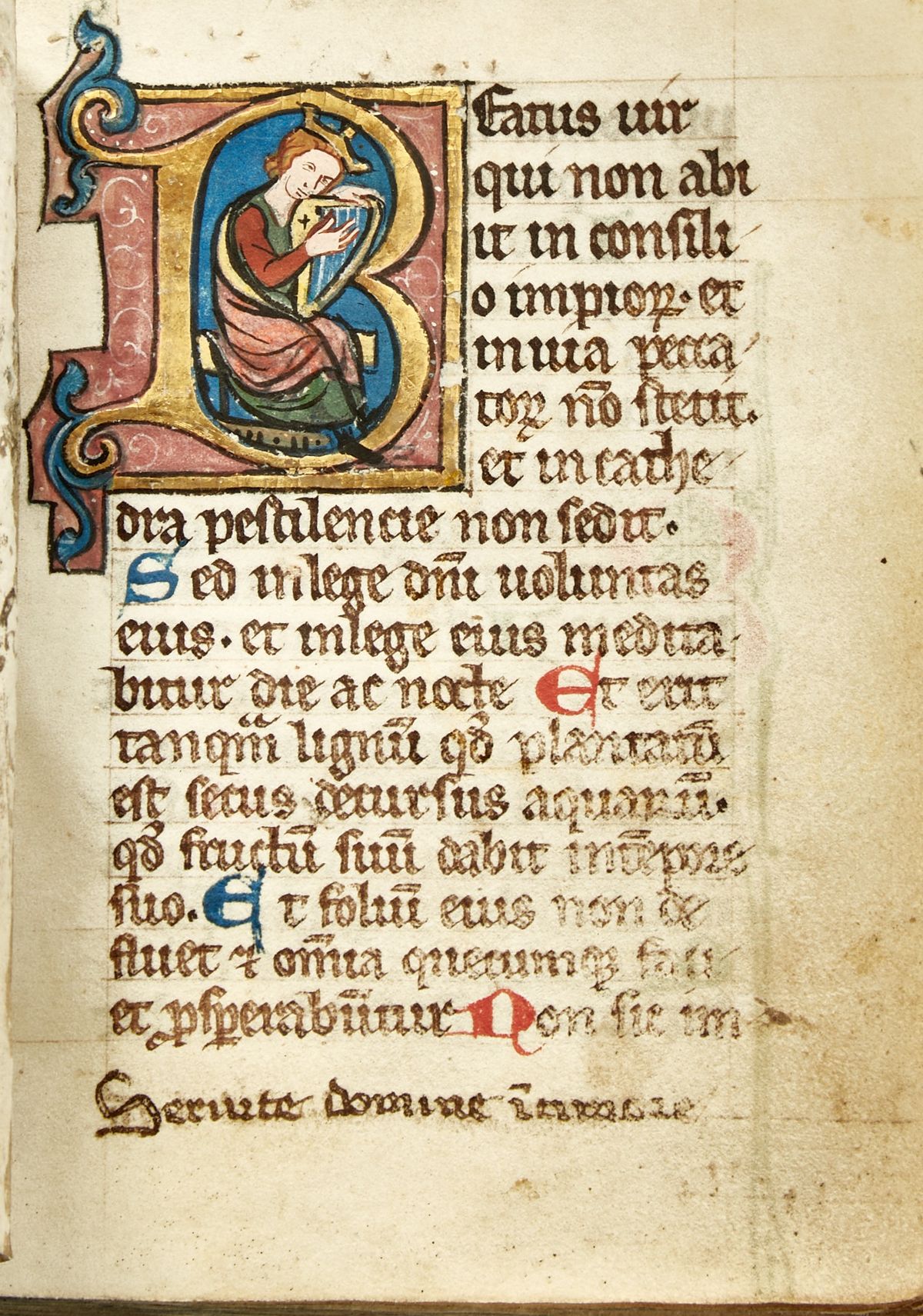
A psalter with a single historiated Beatus initial “B” featuring Kind David playing his harp was offered by Doyle for their April 16, 2026 auction titled Rare Books, Autographs & Maps. I took an interest in the piece and noted a rich recent history of ownership and broader comment on mid-market manuscripts as stores of value.
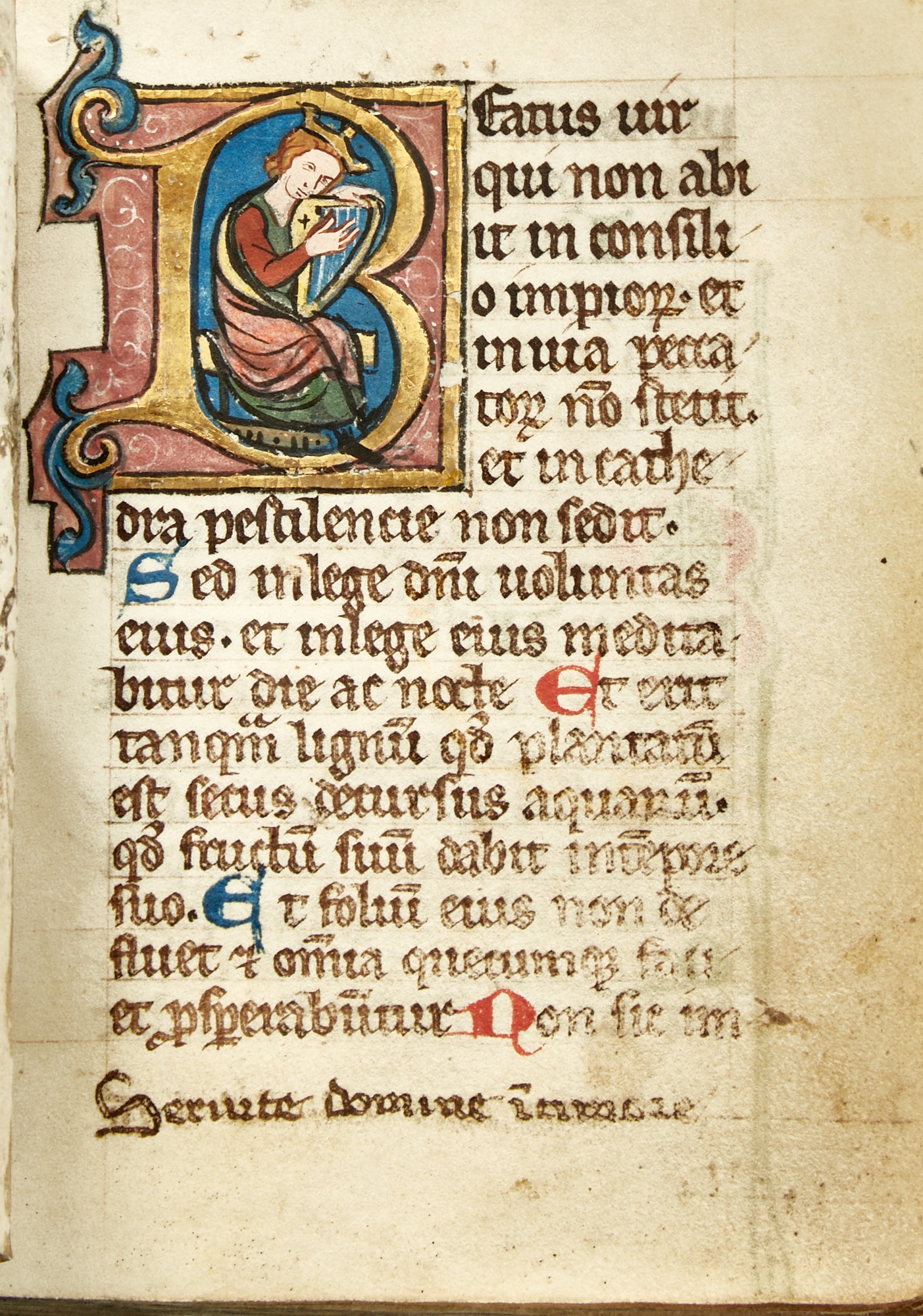
The Psalter originating from Cologne, is dated to 1270-1280, and for the most part intact 270 ff. (lacking a final leaf) with a 16th century binding. It exhibits a beautiful “B” historiated Beatus initial with 20 sizable illuminated initials recorded. According to previous auction catalogues, the workshop is attributed to Johannes von Valkenburg (though at first blush I was somewhat skeptical). Compared to other Psalters it is much smaller (consistent with its use as a private devotional), though still much larger than many Books of Hours. The consignor is identified by Doyle Auctions as “the estate of a Larchmont, New York collector.”
The hammer price was $18,000 ($23,040 all-in including Buyer’s Premium), which in my opinion, is a perfectly reasonable price, given the manuscript’s completeness, single richly illuminated initial, and detailed, famous provenance (Sir Thomas Phillipps!).
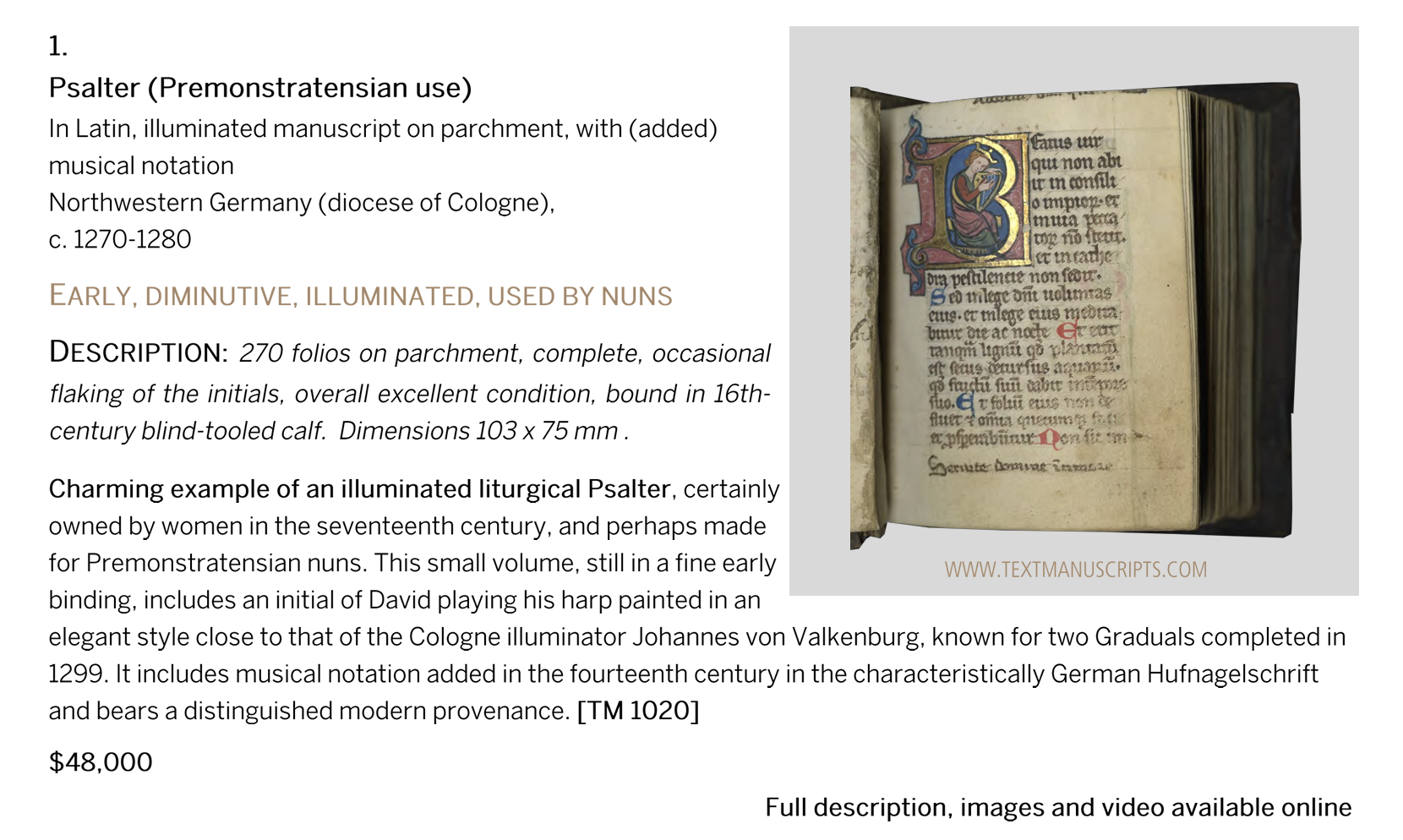
Before we look at the price, let’s look at how the piece has changed as it moved through various experts. Since its acquisition (presumably) by Les Enluminures (Text Manuscripts - catalogued as TM 1020) at Christie’s in 2018, the understanding of this Psalter has been meaningfully enriched. The original Christie’s description conservatively described the manuscript as an early 14th-century Cologne Psalter “in the style of Johannes von Valkenburg,” without much other function or context (basically just an ordinary psalter with good provenance). Les Enluminures tightened the dating to circa 1270-1280 and advanced a much more specific and interesting provenance: Premonstratensian (possibly in a male + female or female-only monastery use). Much deeper analysis can be seen by the Les Enluminures experts here.
The biggest question (at least on the mind of many biders) remains the illumination. Les Enluminures cautiously attributes (similar to Christie’s) to the work of Johannes von Valkenburg, but distances from any named or autograph or even workshop connection. More like “Johannes von Valkenburg was active regionally at the time” thus based on penwork, brush strokes, tendrils of the initial, etc., the initial was influenced by von Valkenburg (but certainly not workshop). Perhaps appropriately, Doyle removed this stretch von Valkenburg attribution, but unfortunately also condensed rather than fully carried forward the deeper context around its use, origin, and provenance that would have significantly contributed to its value.
Perhaps unsurprisingly, the auction price actually places the manuscript’s appreciation as flat at best or negative. At the 2018 Christie’s auction, the piece sold for a hammer of $15,000 GBP, or closer to $24,000 all-in accounting for historic fx. It was listed by Les Enluminures Text Manuscripts website as early as 2019 and featured in the 2020 e-Catalogue One Exploring Text Manuscripts: Women and the Book as the headliner piece listed for $48,000 USD. Starting 2021, the website listing was changed to SOLD. Unless it was heavily discounted, the same buyer in 2021 almost certainly lost money, and if Les Enluminures has not sold the piece, it would be flat at best or slightly negative in 2026.
Commentary: Observing various auction outcomes from Jan-April 2026, the sale of this Psalter signals to me that there are many entry-level manuscript buyers (range of $1,000-$2,700 hammer) and a sharp drop in available bidders at the middle market. Thus, manuscripts in the $10,000-$50,000 range appear to be flat without many determined buyers in this range. Said another way is, unless there is serious and recognizable historical significance or incredibly beautiful art or named illuminator/workshop, many manuscripts in the mid-market range are fungible and provenance does not make up for it. This may signify that serious manuscript collectors/institutions with active resources are a thin pool of buyers who are very savvy, or presumably there is a very high capital and knowledge barriers for entry and bidders may appreciate historical significance but won’t vote with their wallets.
I don’t run an auction house nor am I a dealer, but if I had to list the piece, I would have leaned heavily on the historical positioning of early Psalters as a sort of “proto-Books of Hours” to increase relatability to buyers, and its early use by Nuns as Les Enluminures noted (early female use broadens the impact and reach of historical objects). Stripping even the tenuous link to Johannes von Valkenburg likely hurt more than expected, leaving the single “B” initial to carry the entire object.
In conclusion, this piece, despite its provenance, is really treated as a regular text/context-heavy manuscript and at best mediocrely retained some value - albeit an extremely weak store of value, certainly not an investment when accounting for general market inflation in the comparable time period. Does this conclusion echo the broader mid-market of manuscripts? Not sure; I’ll have to see if this pattern holds in other text manuscripts, large Italian initials, and potentially incunables. Conversely, the 2021 sale by Les Enluminures may signal that deep research may actually drive prices up (substantially) for the right buyer and there was value that was held back at the 2026 Doyle auction . More examples will have to be tracked to account for otherwise noisy times of 2020-2021 with high inflation driving speculators into various illiquid assets and collectibles.